What Term Is Used to Describe the Short Recurring Motives Found in Wagners Work?

A leitmotif or leitmotiv [ane] () is a "curt, recurring musical phrase"[2] associated with a particular person, place, or thought. Information technology is closely related to the musical concepts of idée fixe or motto-theme.[2] The spelling leitmotif is an anglicization of the German language Leitmotiv (IPA: [ˈlaɪtmoˌtiːf]), literally meaning "leading motif", or "guiding motif". A musical motif has been defined equally a "brusk musical idea ... melodic, harmonic, or rhythmic, or all iii",[1] a salient recurring effigy, musical fragment or succession of notes that has some special importance in or is characteristic of a limerick: "the smallest structural unit possessing thematic identity."[3]
In particular, such a motif should be "clearly identified and then as to retain its identity if modified on subsequent appearances" whether such modification be in terms of rhythm, harmony, orchestration or accessory. Information technology may also be "combined with other leitmotifs to advise a new dramatic condition" or development.[1] The technique is notably associated with the operas of Richard Wagner, and well-nigh especially his Der Ring des Nibelungen, although he was not its originator and did non employ the give-and-take in connection with his work.
Although ordinarily a short melody, it tin can likewise exist a chord progression or even a simple rhythm. Leitmotifs tin help to bind a piece of work together into a coherent whole, and also enable the composer to chronicle a story without the use of words, or to add an actress level to an already present story.
By association, the word has likewise been used to mean any sort of recurring theme (whether or not field of study to developmental transformation) in literature, or (metaphorically) the life of a fictional character or a existent person. It is sometimes likewise used in discussion of other musical genres, such every bit instrumental pieces, cinema, and video game music, sometimes interchangeably with the more than general category of theme.
Classical music [edit]
Early instances in classical music [edit]
The use of characteristic, brusk, recurring motifs in orchestral music can be traced back to the early on seventeenth century, such every bit Fifty'Orfeo by Monteverdi. In French opera of the late eighteenth century (such equally the works of Gluck, Grétry and Méhul), "reminiscence motif" tin be identified, which may recur at a significant juncture in the plot to found an association with earlier events. Their use, however, is not extensive or systematic. The power of the technique was exploited early in the nineteenth century by composers of Romantic opera, such as Carl Maria von Weber, where recurring themes or ideas were sometimes used in association with specific characters (east.g. Samiel in Der Freischütz is coupled with the chord of a diminished seventh).[ii] The first utilise of the word leitmotif in impress was by the critic Friedrich Wilhelm Jähns in describing Weber's work, although this was not until 1871.[1]
Motifs as well figured occasionally in purely instrumental music of the Romantic period. The related idea of the musical idée fixe was coined by Hector Berlioz in reference to his Symphonie fantastique (1830). This purely instrumental, programmatic work (subtitled Episode in the Life of an Creative person … in 5 Sections) features a recurring melody representing the object of the artist's obsessive affection and depicting her presence in various existent and imagined situations.
Though perhaps non respective to the strict definition of leitmotif, several of Verdi'due south operas characteristic similar thematic tunes, oftentimes introduced in the overtures or preludes, and recurring to mark the presence of a character or to invoke a particular sentiment. In La forza del destino, the opening theme of the overture recurs whenever Leonora feels guilt or fear. In Il trovatore, the theme of the outset aria by Azucena is repeated whenever she invokes the horror of how her female parent was burnt alive and the devastating revenge she attempted then. In Don Carlos, at that place are at least 3 leitmotifs that recur regularly across the five acts: the commencement is associated with the poverty and suffering from state of war, the 2d is associated with prayers around the tomb of Carlos V, and the third is introduced as a duet between Don Carlo and the Marquis of Posa, thereafter accentuating sentiments of sincere friendship and loyalty.
Wagner [edit]

Siegfried's horn phone call leitmotif from the prologue to Human activity I of Wagner'south opera Götterdämmerung, the quaternary of his Ring cycle The theme is broader and more richly orchestrated than its earlier appearances, suggesting the emergence of Siegfried'southward heroic character.

A more sinister version of the horn call motif, articulated equally a half-diminished 7th arpeggio, "music of dark strength and magnificence," occurs in "Hagen'southward Sentinel" towards the end of Act 1 of Götterdämmerung. Hagen, who eventually murders Siegfried, contemplates ways of using the benighted hero to further his own ends.[four]
Richard Wagner is the primeval composer most specifically associated with the concept of leitmotif. His bicycle of four operas, Der Ring des Nibelungen (the music for which was written betwixt 1853 and 1869), uses hundreds of leitmotifs, often related to specific characters, things, or situations. While some of these leitmotifs occur in just one of the operas, many recur throughout the entire cycle.[5] [half dozen] Wagner had raised the issue of how music could best unite disparate elements of the plot of a music drama in his essay Opera and Drama (1851); the leitmotif technique corresponds to this ideal.[7]
Some controversy surrounded the use of the give-and-take in Wagner'southward ain circumvolve: Wagner never authorised the use of the word leitmotiv, using words such as Grundthema (basic idea), or simply Motiv. His preferred proper noun for the technique was Hauptmotiv (principal motif), which he start used in 1877;[2] the only fourth dimension he used the give-and-take Leitmotiv, he referred to "so-chosen Leitmotivs".
The give-and-take gained currency with the overly literal interpretations of Wagner's music by Hans von Wolzogen, who in 1876 published a Leitfaden (guide or manual) to the Ring. In it he claimed to have isolated and named all of the recurring motifs in the bike (the motif of "Servitude", the "Spear" or "Treaty" motif, etc.), oft leading to absurdities or contradictions with Wagner's bodily practice.[viii] Some of the motifs he identified began to appear in the published musical scores of the operas, arousing Wagner's annoyance; his wife Cosima Wagner quoted him every bit proverb "People will think all this nonsense is done at my request!".[nine] In fact Wagner himself never publicly named any of his leitmotifs, preferring to emphasize their flexibility of clan, role in the musical form, and emotional outcome. The exercise of naming leitmotifs still continued, featuring in the work of prominent Wagnerian critics Ernest Newman, Deryck Cooke and Robert Donington.[4]
The resulting lists of leitmotifs also attracted the ridicule of anti-Wagnerian critics and composers (such as Eduard Hanslick, Claude Debussy, and Igor Stravinsky). They identified the motif with Wagner'southward own approach to composing, mocking the impression of a musical "address book" or list of "cloakroom numbers" it created.
However, after commentators have defended Wagner'south use of the leitmotif. According to Pierre Boulez, "Wagner's was the kickoff music in which forms never return literally, are never repeated. Equally the music progresses, it carries all the thematic elements with it, linking them in new means, placing them in different relations to each other, showing them in unfamiliar lights and giving them unexpected meanings." Boulez adds: "Leitmotivs are in fact anything but the traffic signals to which they have been mistakenly compared, for they have a double virtue – both poetic and dramatic, besides as formal. They are essential to the structure of both music and drama also as to the different characters and situations. Their evolution is a kind of 'fourth dimension-weave', an integrating of past and present; and they also imply dramatic progression."[x]
After Wagner [edit]
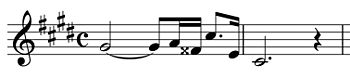
The leitmotif associated with Salome herself in Richard Strauss's opera Salome
Since Wagner, the use of leitmotifs has been taken up by many other composers. Richard Strauss used the device in many of his operas and several of his symphonic poems. Despite his sometimes acerbic comments on Wagner, Claude Debussy utilized leitmotifs in his opera Pelléas et Mélisande (1902). Arnold Schoenberg used a complex prepare of leitmotifs in his choral work Gurre-Lieder (completed 1911). Alban Berg's opera Wozzeck (1914–1922) also utilizes leitmotifs.[one] The leitmotif was besides a major feature of the opera The Immortal Hour by the English language composer Rutland Boughton. His constantly recurrent, memorably tuneful leitmotifs contributed significantly to the widespread popularity of the opera. In Prokofiev'south Peter And The Wolf (1936) each character or animate being has its own leitmotif played on a particular instrument.
Critique of the leitmotif concept [edit]
The critic Theodor W. Adorno, in his book In Search of Wagner (written in the 1930s), expresses the opinion that the entire concept of the leitmotif is flawed. The motif cannot exist both the bearer of expression and a musical "gesture", because that reduces emotional content to a mechanical process. He notes that "fifty-fifty in Wagner's own day the public fabricated a crude link between the leitmotifs and the persons they characterised" because people's innate mental processes did not necessarily correspond with Wagner's subtle intentions or optimistic expectations. He continues:
The degeneration of the leitmotiv is implicit in this ... it leads directly to cinema music where the sole function of the leitmotif is to announce heroes or situations and then as to allow the audience to orient itself more hands.[11]
Entertainment [edit]
The primary ideology backside leitmotif is to create a sense of attachment to that particular audio that evokes audiences to feel particular emotions when that sound is repeated through the pic. Leitmotifs in Adorno's "degenerated" sense often occur in film scores, and have since the early decades of sound moving-picture show. One of the showtime people to implement leitmotif in early sound films was Fritz Lang in his revolutionary hitting M. Lang set the benchmark for sound motion picture through his use of leitmotif, creating a unlike type of atmosphere in his films.
- In the film Psycho (1960), composer Bernard Herrmann created a 3 note leitmotif that is commencement heard when Norman Bates covers upwardly the murder of Marion Crane committed by his "mother" and can be heard throughout the film in certain scenes involving both Norman and/or his Mother. John Williams would later pay tribute to Bernard Herrmann past using a similar iii note leimotif in Star Wars: Episode IV - A New Hope (1977) when Han Solo, Obi-Wan Kenobi, Luke Skywalker, and Chewbacca emerge from the Millennium Falcon'south smuggling compartments.
- In the Jaws franchise, the master "shark" theme, composed by John Williams in 1975, stands out as a suspenseful motif that is a elementary alternating pattern of two notes, E and F.[12]
- In the beginning Star Wars flick in 1977, John Williams used a large number of themes specifically associated with people and concepts, and he would expand upon this concept for the following films of the original trilogy (for example, a particular motif is attached to the presence of Darth Vader, another to the concept of the Death Star, and another to the concept of the Strength). Williams would later revisit this material for the prequel trilogy starting in 1999, then once more for the sequel trilogy starting in 2015, each fourth dimension crafting new themes while incorporating the one-time. Other composers would utilize some of Williams' iconic leitmotifs in spin-off material.[xiii]
- In the 1989 film Batman, Danny Elfman composed the heroic theme for the titular grapheme, which is besides used in the afterwards film.[14]
- The 1993 theme for Schindler's List by John Williams is repeated throughout the film, and it is considered to be one of the most recognized contemporary film leitmotifs, specifically the violin solo.[15]
- The 1994 video game Terminal Fantasy 6 has a leitmotif for each of the xiv main characters, major villains, also as certain themes.
- The 1997 video game Final Fantasy Seven has a leimotif that plays subsequently a monster boxing, also serving equally the game'south victory music.
- In Titanic (1997), composer James Horner used a number of recurring leitmotifs that are associated with the pic'due south romance, tragedy and the disaster.[16]
- John Williams equanimous the music for the starting time three Harry Potter movies starting in 2001, and leitmotifs are prominently utilized to correspond specific characters, feelings, and locations, most notably the rails entitled Hedwig's Theme. While Williams did non score the residue of the franchise, this theme would consistently return in the scores of later on composers Patrick Doyle, Nicholas Hooper, Alexandre Desplat, and James Newton Howard equally they worked on the final films and spin-offs.[17]
- In The Lord of the Rings film series starting in 2001, composer Howard Shore prominently utilizes a vast amount of interconnecting leitmotifs to convey the ideas supporting specific characters, locations, and overall landscape of Heart-earth. His score is noteworthy considering there is no singular "master theme" for the serial, only a choice of several could hold this title, including the themes for the Fellowship, the Ring of Ability, Lothlórien, the Shire, Isengard, Mordor, Rohan, and Gondor. Variations in these themes convey the changes that occur to the corresponding subjects throughout the trilogy. For the prequel Hobbit trilogy starting in 2012, Shore revists some of these themes while introducing new leitmotifs for some of the new characters, such as Bilbo Baggins, Smaug, and the dwarves.[eighteen]
- Composed by Hans Zimmer, Klaus Badelt, and Geoff Zanelli, the Pirates of the Caribbean motion-picture show serial consists of several motifs and themes associated with the protagonists, villains and moods starting in 2003. One prominent motif is "He's a Pirate", which is associated with pirates in general and the heroic action sequences they are involved in. Besides the full general leitmotifs, specific characters such as Jack Sparrow, Davy Jones, Angelica, and Salazar each take their own unique motifs.[19]
- The Nighttime Knight trilogy features several recurring themes and motifs for Batman, the villainous characters, and action scenes composed by Hans Zimmer and James Newton Howard starting in 2005.[20]
- In the Marvel Cinematic Universe serial of films and shows, two reoccurring leitmotifs are prominently featured: Alan Silvestri's theme for the Avengers team and Ludwig Göransson's theme for the Wakanda setting.[21]
- In the 2009 film Avatar, James Horner uses a couple of leitmotifs related to the characters, romance, locations and creatures.[22]
- Premiering in 2015, Hamilton: An American Musical uses several leitmotifs throughout to introduce characters and reinforce connections, composed and written primarily by Lin-Manuel Miranda. Nearly all characters have a trademark leitmotif, for case the style the main character Alexander Hamilton sings his name.[23]
- In Toby Fox'southward 2015 video game Undertale and its 2018 spiritual successor Deltarune, thematic and character connections are oftentimes portrayed using leitmotifs, with the most notable examples being the primary themes of each game: "Undertale" and "Don't Forget" respectively. [24]
See also [edit]
 | Look up leitmotif in Wiktionary, the costless dictionary. |
- Epitome vocal
- Motif (music)
- Motif (literature)
- Motif (art)
- Ostinato
- Theme music
References [edit]
- ^ a b c d e Sadie, Stanley; Tyrrell, John, eds. (2001). The New Grove Dictionary of Music and Musicians. London: Macmillan Publishers.
- ^ a b c d Kennedy, Michael (1987). The Curtailed Oxford Lexicon of Music. Oxford: Oxford University Press. ISBN978-0-19-311320-vi.
- ^ White, John (1976). The Analysis of Music. Prentice-Hall. pp. 26–27. ISBN9780130332332.
- ^ a b Donington, Robert (1976). Wagner's 'Ring' and its Symbols. Faber and Faber Limited. p. 226. ISBN978-0571048182.
- ^ Millington, Barry, ed. (2001) [1992]. The Wagner Compendium: A Guide to Wagner's Life and Music. Thames & Hudson. pp. 234–235. ISBN978-0500282748.
- ^ Grout, Donald; Williams, Hermine (2003). A Curt History of Opera (quaternary ed.). New York: Columbia University Press. ISBN0-231-11958-5.
- ^ Sutton, Richard (1979). Burbidge, Peter (ed.). The Wagner Companion. London: Cambridge Academy Press. pp. 345–346. ISBN0-571-11450-four.
- ^ Gray, Thomas, ed. (2009). Richard Wagner and His World. Princeton: Princeton University Press. ISBN978-0-571-11450-4.
- ^ Wagner, Cosima (1978) [1878-1883]. Gregor-Dellin, Martin; Mack, Deitrich (eds.). Cosima Wagner'south Diaries. Vol. two. Translated by Skelton, Geoffrey. Harcourt Caryatid Jovanovich. ISBN978-0151226368.
- ^ Boulez, Pierre (1990). Nattiez, Jean-Jacques (ed.). Orientations: Collected Writings. Translated by Cooper, Martin. Harvard University Press. p. 251. ISBN978-0674643765.
- ^ Adorno, Theodor (2009) [1952]. In Search of Wagner. Translated by Livingstone, Rodney. London: Verso. ISBN978-1844673445.
- ^ Matessino, Michael (24 September 1999). "Letter in response to "A Study of Jaws' Incisive Overture To Shut Off the Century"". filmscoremonthly.com. Archived from the original on 17 October 2006. Retrieved 17 December 2006.
- ^ Ross, Alex (three Jan 2018). "A Field Guide to the Musical Leitmotifs of "Star Wars"". The New Yorker . Retrieved 11 Baronial 2021.
{{cite magazine}}: CS1 maint: url-status (link) - ^ Doerschuk, Robert L. (October 1989). "Danny Elfman – The Agony & The Ectasy of Scoring Batman". Keyboard. Vol. 15, no. x. GPI Publications. pp. 82–95. Retrieved 12 January 2018.
- ^ "Review Of: John Williams – Schindler's List (Theme Vocal)". AudiophileParadise. 20 August 2012. Retrieved 22 May 2021.
- ^ "James Horner – Titanic". Mfiles. Retrieved 1 January 2016.
- ^ Roberts, Maddy Shaw (8 September 2020). "Harry Potter soundtrack: 'Hedwig's Theme' and everything to know about the moving picture franchise's magical score". Classic FM . Retrieved 4 August 2021.
{{cite web}}: CS1 maint: url-status (link) - ^ Keane, Paul (five August 2021). "Howard Shore in The Lord of The Rings: How to use leitmotif technique to create a masterpiece?". TakeTones.Com . Retrieved 11 August 2021.
{{cite web}}: CS1 maint: url-status (link) - ^ Schweiger, Daniel (16 May 2011). "Audio: On The Score With Hans Zimmer". Film Music Magazine. Retrieved 7 August 2011.
- ^ D., Spence (xiii June 2005). "Batman Vs. Hans Zimmer and James Newton Howard Part 2". IGN . Retrieved 1 December 2006.
- ^ Reynolds, Jeremy (9 May 2018). "Here's why the music in Marvel superhero movies is and then forgettable". Pittsburgh Post-Gazette . Retrieved 26 July 2021.
{{cite spider web}}: CS1 maint: url-status (link) - ^ Jim Dorey (two April 2008). "Na'vi Alien Linguistic communication Incorporated In 'Avatar' Music Soundtrack". MarketSaw Blog. Archived from the original on 8 April 2008. Retrieved 21 April 2008.
- ^ "Hamilton and Leitmotif". Tumblr. 12 Baronial 2016. Retrieved 10 June 2021.
- ^ "An Examination of Leitmotifs and Their Use to Shape Narrative in UNDERTALE - Part 1 of two". Jason Thousand. Yu. 1 April 2016. Retrieved 17 Jan 2022.
williamspurabbighty.blogspot.com
Source: https://en.wikipedia.org/wiki/Leitmotif
0 Response to "What Term Is Used to Describe the Short Recurring Motives Found in Wagners Work?"
Post a Comment